

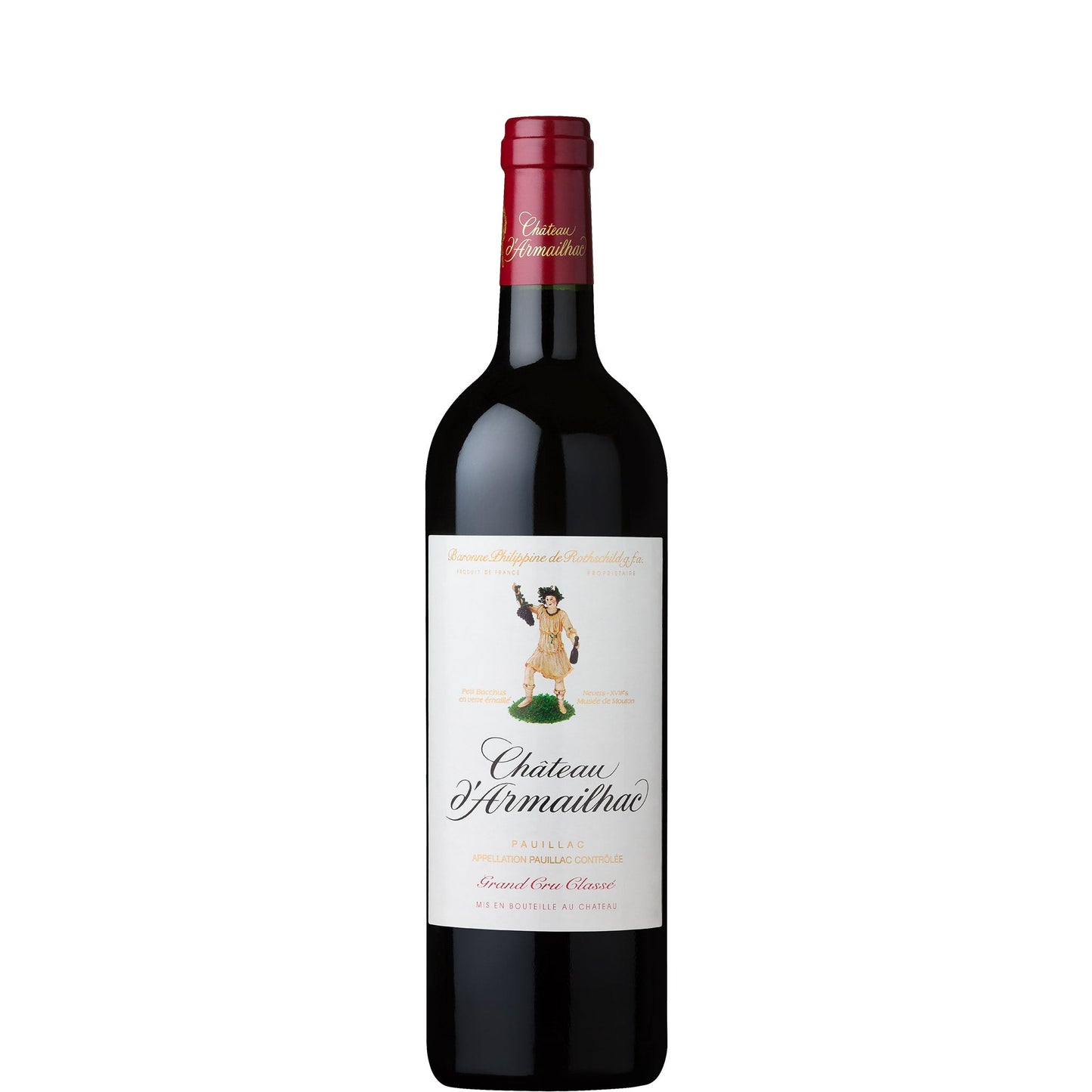
Château D'Armailhac, 2017
Château D'Armailhac, 2017
- 75cl
- 13.5%
- Red Still
- Cabernet Sauvignon, Merlot, Cabernet Franc, Petit Verdot
Couldn't load pickup availability

Optimal drinking window: Now - 2040
Cases of 12 are presented in original wooden cases.
Château d'Armailhac sits comfortably in Pauillac's inner circle as a fifth growth with ambitions well above its classification. Owned by the Rothschild family of Mouton fame, it shares both a postcode and a philosophy with its illustrious neighbour, yet carves its own identity: a little more Cabernet Franc in the mix, and a style that leans towards finesse rather than sheer power.
The 2017 vintage tested Bordeaux with a brutal spring frost, but the estates that managed their fruit carefully came through with wines of real precision, and d'Armailhac is a strong example of that. The blend here is a classically Pauillac backbone with Cabernet Franc adding a lifted, aromatic edge. Blackcurrant and black cherry fruit sit alongside pencil shavings, wild sage, and cedar, all framed by fine-grained tannins and a refreshing mineral lift on the finish.
At the time of writing, in 2026, the wine is moving out of its tightly wound early phase and becoming genuinely approachable, with the primary fruit still vivid and the tannins softening into something more giving. Over the next three to five years, the blackcurrant and cherry will begin to integrate with the cedar and earthy spice, and secondary complexity — dried herbs, graphite, a little leather — will start to take hold. The peak window is probably 2028 to 2038, when the fruit, structure, and emerging complexity should all be in balance.
What the critics say:
"Lots of chocolate and berry aromas with currants. Full-bodied, round and juicy with hints of blueberries and white pepper. Long and flavorful. Firm. A blend of 68% cabernet sauvignon, 22% merlot, 7% cabernet franc and 3% petit verdot. Needs another two or three years to soften. Better after 2022."
"A blend of 68% Cabernet Sauvignon, 22% Merlot, 7% Cabernet Franc, and 3% Petit Verdot, the 2017 d’Armailhac is deep garnet-purple in color. It shoots from the glass with vibrant notions of fresh blackcurrants, black cherries, and black raspberries, plus hints of wild sage, pencil lead, cedar chest, and lavender. Light to medium-bodied, the palate is tightly knit and refreshing, featuring fine-grained tannins and delicate red and black fruit layers, finishing with a mineral lift."
Tasting Notes
AppearanceDeep garnet-purple with good concentration and a clean, bright rim.
NoseVibrant blackcurrant and black cherry up front, with Cabernet Franc adding a lifted note of wild sage and lavender. Underneath, cedar, pencil shavings, and a faint whisper of black olive give it that unmistakably Pauillac depth.
PalateMedium to full-bodied, with more energy and freshness than you might expect from the vintage — the fruit is tightly knit rather than opulent, with fine-grained tannins that have begun to soften. Red and black fruit layers build steadily, with an earthy, spice-box quality emerging mid-palate.
FinishLong and precise, with a mineral lift and the kind of clean, savoury persistence that good Pauillac always delivers.
Overall impressionA vintage that surprised the sceptics, and a wine that makes a strong case for d'Armailhac's place among the Médoc's most consistent overachievers.
Food Pairings
In the Médoc, this is wine built to sit alongside the region's classic lamb — specifically agneau de Pauillac, the milk-fed lamb raised on the estuary's salt marshes, roasted simply with garlic and thyme. The local obsession with entrecôte bordelaise, grilled rib-eye finished with bone marrow and a shallot-red wine sauce, is equally at home here. Further afield in Bordeaux's culinary tradition, duck confit with lentils or a simple roast pigeon would work a treat. For something more relaxed, a well-aged comté or a firm Cantal is all you need to let the wine do the talking.
We think this wine would go well with
Serve at around 17-18°C — too warm and the fruit becomes jammy, too cool and the tannins close in. Decanting for 45 minutes to an hour will help open up the nose and soften the tannins without losing the freshness that makes this vintage distinctive. A large-bowled Bordeaux glass gives the wine enough room to breathe and lets the cedar and sage aromatics build properly.
The vineyards lie on the plateau and slopes of Pauillac, where deep Günzian gravel over clay and limestone subsoils provide both excellent drainage and a steady supply of water in dry vintages. The gravel warms quickly in the growing season, favouring Cabernet Sauvignon ripening, while the cooler clay beneath moderates the vines during summer heat. This combination produces wines with dark fruit concentration but without losing the freshness and mineral precision that defines the best Pauillac. The 2017 frost affected lower-lying parcels across the Médoc, but d'Armailhac's elevated gravel plots largely escaped the worst of it.
Pauillac is the most celebrated commune in the Médoc, home to three of the five first growths — Lafite, Latour, and Mouton Rothschild — as well as a host of second and fifth growths that would be premiers in almost any other appellation. The rules are standard Médoc AOC: red wines only, Cabernet Sauvignon dominant, with Merlot, Cabernet Franc, and Petit Verdot permitted in the blend. What sets Pauillac apart from its neighbours Saint-Julien and Saint-Estèphe is the depth of its gravel soils and the concentration and structure those soils consistently deliver. The wines tend to be more powerful and tannic than Saint-Julien, with more fruit generosity than Saint-Estèphe at a similar age.
The 2017 growing season in Bordeaux reads like a masterclass in how vines adapt to extremes. April frost damaged budbreak across the region, reducing yields significantly, then July and August delivered serious heat that pushed ripening along at pace. The saving grace came with cooler nights and a perfectly timed return to moderate conditions in September, allowing whatever fruit remained to develop proper balance rather than simply racing to sugar.
What emerged was a vintage of surprising concentration—not because the fruit was inherently powerful, but because there was simply less of it to go around. The Cabernets, particularly Cabernet Sauvignon, show real intensity without the hard edges that scorching summers often produce, while Merlot varies more dramatically depending on terroir and timing. We find these wines drinking beautifully now, offering immediate pleasure with their forward fruit and supple tannins, though the better examples will happily cruise until 2030. This isn't a vintage for the cellar obsessives, but for those who actually open bottles.
FAQs
What does the 2017 Château d'Armailhac taste like?
This is a Pauillac of precision rather than brute power. Blackcurrant, black cherry, and cedar sit alongside wild sage, pencil shavings, and a mineral lift on the finish. The tannins are fine-grained and the overall feel is tightly knit, with real freshness for the vintage.
When should I drink the 2017 d'Armailhac?
It is drinking well now, and will continue to improve until around 2030-2038. If you can hold on for a couple more years, the secondary complexity — dried herbs, graphite, a little spice box — will start to show more clearly.
Is the 2017 vintage worth buying for a fifth growth Pauillac?
Yes, and more than the vintage's mixed reputation might suggest. The spring frost hit lower-lying vineyards hard across the Médoc, but d'Armailhac's elevated gravel plots came through well, and the critics' scores reflect that — all sitting comfortably in the 91-94 range. It is a wine that overdelivers for its classification and its vintage.
What food should I serve with this wine?
Classic Médoc territory: roast lamb with garlic and thyme, duck confit, or a rib-eye with a red wine and shallot sauce. If you are keeping things simple, a well-aged comté is all you need alongside a good glass of this.
How should I serve the 2017 d'Armailhac?
Serve at 17-18°C and decant for 45 minutes to an hour before pouring. A large-bowled Bordeaux glass will give the aromatics room to develop. Avoid serving it too warm — the freshness is one of this vintage's best qualities and higher temperatures will mute it.
How does d'Armailhac compare to its Pauillac neighbours?
As a fifth growth within the Rothschild stable, it shares winemaking expertise with Mouton Rothschild but at a fraction of the price. It is less monumental than Latour and less perfumed than Pichon Lalande, but it offers genuine Pauillac character — dark fruit, structure, mineral depth — with a elegance that consistently outpaces its classification.

OUR GROWERS
Château D'Armailhac
Explore related wines


What are you looking for tonight? Tell me the occasion, a grape, a region — or just try a suggestion below.
Your recommendations will appear here.
-
-
Speak to one of our Wine Gurus
Speak to a Wine GuruWith years of experience, our team can help you with all your wine buying and selling needs