

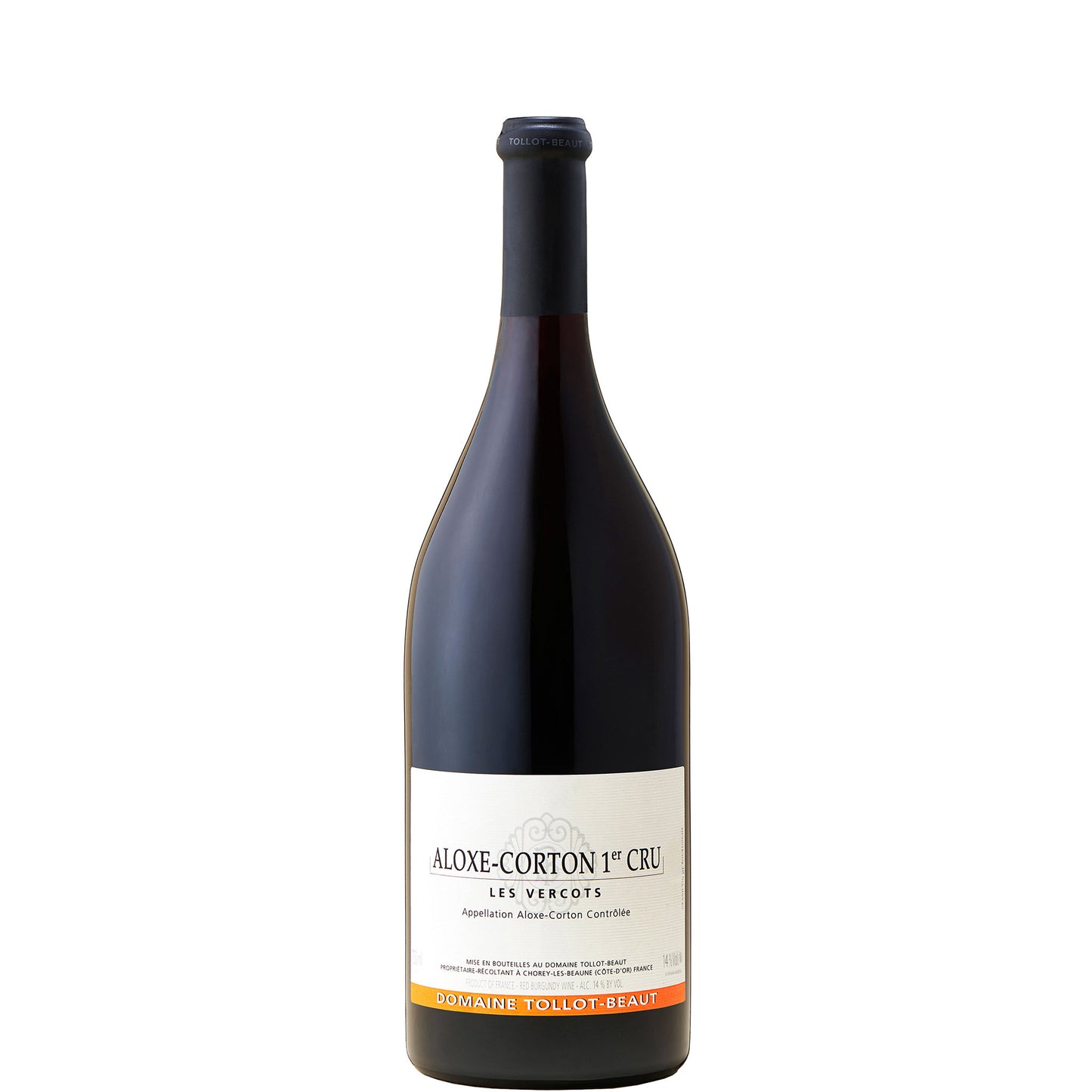
Aloxe Corton 'Les Vercots' rouge, Domaine Tollot-Beaut, 2024
Aloxe Corton 'Les Vercots' rouge, Domaine Tollot-Beaut, 2024
- 75cl
- 13%
- Red Still
- Pinot Noir
Couldn't load pickup availability

Optimal drinking window: 2028 - 2038
Les Vercots is one of Aloxe-Corton's most respected premier cru lieux-dits, sitting high on the hill beneath the Grand Cru belt with a northerly lean that keeps things cool and precise. Tollot-Beaut have farmed it for generations and handle it with characteristic straightforwardness; no fuss, no over-extraction, just good Pinot Noir given the space to say something honest about where it comes from.
The 2024 vintage produced wines of real freshness and delineation across the Côte de Beaune, and this is no exception: it has that characteristic Aloxe tension between red fruit and something more mineral and earthy that makes the appellation worth paying attention to.
"As to the style, 2024 is definitely a cooler vintage with good freshness and transparency and it makes me think of our 2010s. I was very impressed by the quality I found here and a number of the wines are very much worth your interest."
Allen Meadows, Burghound on Tollot Beaut's 2024 vintage
Right now, in 2026, Les Vercots is a little tight and the components have not yet found their full equilibrium — the fruit and structure are both present but slightly separate. By 2028-2030 we expect the tannins to have softened into the wine and the red fruit to have taken on a darker, more complex character with leather and game beginning to appear. The plateau of drinking, where everything is in balance, is likely to run from around 2030 to 2035. After that, the fruit will slowly recede and the mineral and earthy notes will dominate, which for lovers of mature Burgundy is not a bad thing — just a different wine. Drinking until 2038 is a reasonable horizon, with well-stored bottles perhaps offering pleasure a little beyond that.
What the critics say:
"A very fine pinot selection, which immediately shows in the quality of the nose. The wood is currently toughening up the palate just a little, but this too will pass, and the essential quality of this wine is first rate. Tasted from an old barrel more vanilla on the nose, but the fruit takes the upper hand in the mouth. Drink from 2028-2033. Tasted Oct 2025. *4/5 stars*"
"Distinctly sauvage-suffused aromas of violet, just turned earth, black raspberry and discreet spice wisps are trimmed in all but invisible wood. There is a bit more power if not concentration to the utterly delicious and caressing medium weight flavors that exude evident minerality on the more complex, youthfully austere and moderately rustic finale. Some patience will be needed here as this is quite firmly structured. 'Outstanding', 'Top Value'"
Tasting Notes
AppearanceClear, mid-ruby with a bright, clean rim and good depth for the vintage.
NoseRed cherry, raspberry leaf, and something faintly ferrous that speaks to the stony upper slope. With a little air, dried rose petals and a whisper of forest floor begin to emerge from behind the fruit.
PalateTaut and precise rather than broad, with fine-grained tannins that grip cleanly without any roughness. The acidity is lively and the fruit — red plum, cranberry — is vivid but not showy; what catches your attention is the mineral thread running through the mid-palate.
FinishLong and dry with persistent iron minerality and a faint savoury lift on the very end.
Overall impressionA serious, site-expressive Burgundy that needs time to fully open up — the bones are excellent.
Food Pairings
In the villages around Beaune, a wine like this would most naturally find itself on the table alongside a slow-roasted guinea fowl with mushrooms and lardons, the kind of dish that brings out the earthy register without overwhelming the wine's precision. Bresse chicken cooked in a cream sauce with morels is another classic Burgundian pairing that works brilliantly with premier cru Aloxe. Locally cured jambon persillé — the cold pressed ham and parsley terrine that appears on every Burgundian table — is simpler but cuts through beautifully with the wine's acidity. A good aged Époisses, if you time it right, is a fine way to finish a bottle.
We think this wine would go well with
Serve at around 16-17°C — slightly cooler than you might expect, which keeps the fruit lifted and the structure defined. A brief decant of 30-45 minutes is worthwhile for a wine this young, more to wake it up than to soften anything. A large-bowled Burgundy glass is the obvious choice, giving the nose room to evolve as the wine warms in the glass over the course of a meal.
Les Vercots sits at the upper end of Aloxe-Corton's premier cru slope, where the soils become stonier and the Jurassic limestone closer to the surface. The altitude and northeast-facing aspect produce a cooler microclimate than the grand cru parcels lower on the hill, which keeps acidity bright and encourages a more mineral, precise style of Pinot Noir rather than a broad or opulent one. The combination of thin, stony soils and good drainage means yields are naturally restrained and concentration comes from the site rather than any intervention in the cellar.
Aloxe-Corton sits at the northern tip of the Côte de Beaune and is unusual in producing significant quantities of both red and white wine at grand cru level — Corton for reds, Corton-Charlemagne for whites. At village and premier cru level, however, it is almost entirely red wine country built around Pinot Noir. The premier crus here, including Les Vercots, tend toward a firmer, more structured style than you find in Volnay or Beaune — there is more iron and earth, less immediately plush fruit — which makes them good candidates for medium-term cellaring. The appellation sits between the more powerful Pernand-Vergelesses to the north and the suppler Savigny-lès-Beaune to the south.
The 2024 growing season in Burgundy was, frankly, a test of nerve. A wet spring brought significant mildew pressure, and vignerons who stayed sharp in the vineyard — working fast, keeping canopies open, reducing yields where necessary — came out the other side with something worth talking about. Summer brought warmer, drier conditions that helped the fruit recover composure, and harvest arrived broadly on the later side, with growers picking carefully to find phenolic ripeness without sacrificing freshness. Quantity was down across much of the Côte, which concentrates minds as much as it concentrates wine.
What emerged is a vintage that rewards those who put the work in. The Pinots we have tasted carry real precision and translucency — not because they are light, but because the acidity is lively and the fruit unforced. Chardonnays from the Côte de Beaune look particularly promising: taut, mineral, with genuine length. This is not a vintage to panic-open. Most village and premier cru reds want three to five years at minimum, with the better appellations drinking well until 2035 and beyond. The whites are more approachable now, though the best will reward patience too.
FAQs
What does Aloxe-Corton Les Vercots taste like?
This is precise, structured Pinot Noir built around red cherry, iron minerality, and dried roses rather than overt fruit power. It has a taut, stony quality that sets it apart from the softer, more plush styles you find further south in the Côte de Beaune.
When should I drink this wine?
We would suggest waiting until at least 2028. The 2024 is well-made but still needs time for its components to integrate. It will drink well until around 2038, with a window of peak drinking likely from 2030 onwards.
Is this wine worth cellaring?
Yes, genuinely. Tollot-Beaut's Les Vercots is consistently one of the more age-worthy wines from the appellation, and the 2024 vintage produced wines with the kind of acidity and structure that reward patience. If you have the space, buy it and leave it alone for a few years.
What food works well with this wine?
Guinea fowl, roast chicken, mushroom dishes, and charcuterie are all natural partners. It is a versatile food wine — the acidity keeps it fresh against richer preparations and the earthy mineral character means it holds its own alongside umami-rich ingredients like mushrooms or aged cheese.
How should I serve it?
At around 16-17°C, which is a touch cooler than room temperature. Decant for 30-45 minutes if drinking young, and use a large Burgundy glass to give the nose the room it needs to develop.
How does Les Vercots compare to other Aloxe-Corton premier crus?
Les Vercots sits near the top of the slope where soils are stonier and thinner, which tends to produce a more mineral, finely structured wine than some of the lower-lying premier crus. It is not the most immediately generous wine from the appellation, but it is one of the most site-specific and rewards cellaring more than most.

Explore related wines


What are you looking for tonight? Tell me the occasion, a grape, a region — or just try a suggestion below.
Your recommendations will appear here.
-
-
Speak to one of our Wine Gurus
Speak to a Wine GuruWith years of experience, our team can help you with all your wine buying and selling needs